
AGRO-FOOD VALUE CHAIN IS A KEY DRIVER TO NIGERIA’S FOOD SECURITY AND SUSTAINABLE DEVELOPMENT – EXPERTS
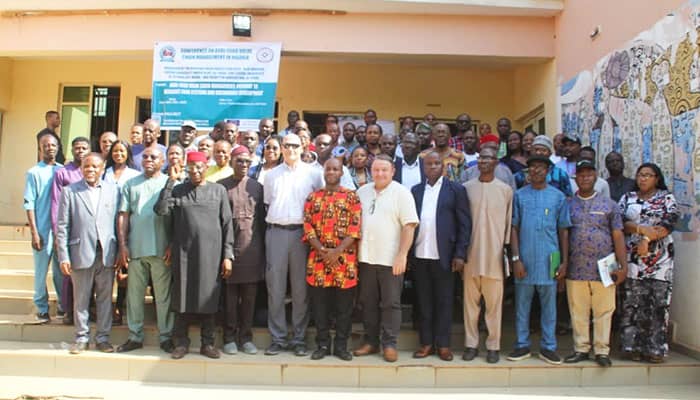
Experts who converged at the Faculty of Agriculture, Alex Ekwueme Federal University Ndufu-Alike, Ebonyi State, two-day international Conference themed “Agro-Food Value Chain Management in Nigeria: Pathway to Resilient Food System and Sustainable Development” have posited that it is a critical strategy for strengthening Nigeria’s food system and advancing sustainable development.
As the country confronts rising food insecurity, climate pressures, and market inefficiencies, they noted that improving the linkages from production to processing, distribution, and consumption has become essential.
They also stated that by adopting integrated, well-coordinated value chain approaches, Nigeria can enhance productivity, reduce postharvest losses, increase competitiveness, and build a more resilient and inclusive agricultural sector capable of supporting long-term national development.
The Chairman of the occasion and President of the Agricultural Society of Nigeria (ASN), Professor Jude Mbanasor, in his opening remarks at the conference called for a comprehensive renewal of Nigeria’s agro-food value chains to strengthen the nation’s food system and accelerate sustainable development.
He emphasized that Nigeria can no longer rely on fragmented agricultural interventions to secure food security for its growing population, highlighting the necessity of building a resilient food system based on well-coordinated value chains production, processing, logistics, markets, and export competitiveness. According to him, enhancing these linkages is crucial for addressing postharvest losses, increasing farmer incomes, attracting investment, and establishing Nigeria as a regional agricultural powerhouse.
Mbanasor also reaffirmed the Agricultural Society of Nigeria’s commitment to driving evidence-based policy reforms and promoting innovations that can unlock agriculture’s economic potential. He urged governments at all levels to support integrated value chain models, strengthen market systems, and provide enabling infrastructure to ensure long-term impacts.
The CHAIN Project Coordinator and Dean, Faculty of Agriculture, Professor Robert Onyeneke, while welcoming participants to the conference, called for urgent reforms in Africa’s agro-food value chains. He warned that weak linkages between production and markets continue to undermine livelihoods, food security, and economic growth, adding that agriculture remains the backbone of survival for millions of Africans and that significant value is lost between farm and fork due to poor logistics, inconsistent standards, postharvest losses, and inadequate market connections.
He noted that AE-FUNAI has been at the forefront of efforts to tackle these systemic challenges through applied research, community engagement, and capacity building. He stressed that ongoing projects focused on climate-smart agriculture, food security, rural livelihoods, resource use efficiency, migration, and sustainable agribusiness development, noting that the university is working closely with farmers, civil society organizations, agribusinesses, and policymakers to ensure that academic research translates into practical solutions that directly benefit rural communities.
Onyeneke further noted the importance of the CHAIN Project initiative, which aims to build the analytical and technical capacities of African researchers in designing and implementing value chain improvements, explaining that programmess in Agricultural Economics, Extension, Agribusiness, Crop Science, Soil Science, Animal Science, and Fisheries are designed to equip graduates with the practical problem-solving skills needed for the 21st-century agricultural economy. And reaffirmed the university’s commitment to strengthening partnerships with local and international organizations to promote technology dissemination, improve productivity, and enhance profitability across the food sector.
Professor Eric Eboh, the lead paper presenter, called for more contexts-responsive and strategically designed value chain interventions to unlock Nigeria’s cassava-garri sector. He stated that smart, well-aligned models could significantly boost food security, job creation, and economic growth across Sub-Saharan Africa.
He also emphasized that the cassava-garri value chain intervention project successfully blends policy support, market development, and coordinated value chain linkages that can transform the country’s most widely consumed staple into an engine for rural prosperity, underpinning that agricultural value chain development holds substantial potential but must be purposefully designed, holistic, and responsive to local realities.
Eboh explained how strengthening the market for garri, Nigeria’s most common cassava product, is essential for stimulating production and improving postharvest handling, processing, and packaging, noting that a vibrant garri market serves as a lever to increase cassava output, stabilize supplies, and create new opportunities for farmers, processors, transporters, and traders.
He also emphasized that a segment-specific intervention approach, which strengthens each stage of the chain while ensuring they reinforce one another, is critical for long-term success, pointing out that the experiences from Delta State can inform similar interventions across Nigeria and other Sub-Saharan African segment-specific the importance of a harmonious and holistic approach to strengthening each segment of the value chain.
The conference was a gathering of academic experts, policy makers, industrialists and large scale farmers.
Category: News Update
Tags:
Comments
No comments yet. Be the first to share your thoughts!
Leave a Comment
Comments are reviewed by our admin team before being published.
Already a member? Log in or Join for ₦1,000/year
Related Articles

How Strong Tower Academy Students Scored Above 340 in 2026 UTME
Students of Strong Tower Academy have revealed the study habits, preparation methods and personal sacrifices that helped many of them achieve outstanding performances in the 2026 Unified Tertiary Matriculation Examination (UTME), with several candidates s
Read More →
ASUU Raises Fresh Strike Threat, Accuses FG of Failing to Honour 2025 Agreement
The Academic Staff Union of Universities (ASUU) has once again sounded the alarm over what it described as the Federal Government’s failure to fully implement the 2025 agreement reached with the union, warning that Nigerian universities may be heading tow
Read More →
NYSC Corps Members to Benefit From New CNG Entrepreneurship Training Programme
The Federal Government of Nigeria has taken another major step toward youth empowerment, economic diversification, and sustainable energy development with the integration of Compressed Natural Gas retrofitting training into the National Youth Service Corp
Read More →