
AE-FUNAI Hosts International Hybrid Conference on Africa’s Security and Development Issues
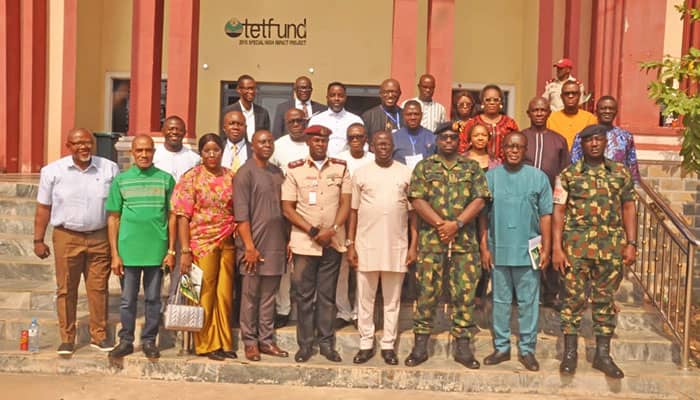
Security experts, personnel and scholars who gathered at the maiden international hybrid conference of the Faculty of Social Sciences, Alex Ekwueme Federal University Ndufu-Alike, Ebonyi State, have proffered solutions to the myriad of socio-economic and environmental challenges facing the Africa continent, with a call for African security thinkers to develop frameworks in addressing the root causes of insecurity beyond military threats.
While declaring the conference open, the Deputy Vice-Chancellor, Administration, Prof. Celestine Afiukwa stressed the critical importance of security to the country’s development, and bemoaned the failure of leadership, which according to him, has exacerbated the issue of insecurity throughout the country. He therefore called for functional and people-oriented leadership in order to arrest the tide, and return Nigeria to the path of sustainable growth and development.
The Dean, Faculty of Social Sciences, Prof. Kalu Uma, in his welcome speech stated that conferences are very important aspect of scholarly activities, given that ideas, insights, new methodologies and new developments in research are often shared while also highlighting solutions for resolving some recurring socio-economic, environmental and political imbroglios bedeviling humanity.
Uma noted that the theme of the conference was pertinent considering the prevailing socio-economic quagmire and security challenges debilitating, menacing and distorting the growth and development of many African countries, Nigeria in particular. He lamented that human, natural and physical resources in Africa were being dislocated due to a high degree of insecurity in the continent.
Uma stressed that the unending issue of insecurity, the problem of “growthlessness”, poor resource management, excessive migration of professionals, high degree of income inequality, climate change and improper development, among others, necessitate a call for innovation and sustainable development.
Concluding, he noted that the African situation is amenable to change; adding that it only requires square pegs in square holes in leadership positions, looking inward, a change of mindset, revival of consciousness of the leaders and the led, among others.
Major General Oluremi A. Fadairo, the General Officer Commanding (GOC) 82 Division of the Nigerian Army, Enugu, and the guest speaker of the conference, who was represented by Brigadier General O.D Bello in his presentation, said that the African development trajectory has been shaped by fragmented approaches that address economic growth, social welfare, and environmental protection. He maintained that contemporary development suggests that reorientation towards integrated security frameworks that simultaneously address socio-economic and environmental issues offers the most viable pathway for achieving sustainable development across Africa.
Brigadier Bello stated that security is the protection of individuals and communities from multidimensional threats to their well-being and dignity, stressing that despite the abundant natural resources, significant economic growth in several regions and an increasing youthful and educated population, the continent continues to grapple with persistent poverty, deepening inequality and accelerating environmental degradation. He observed that the percentage of Africans living in extreme poverty has decreased from 56 percent in 1990 to approximately 43 percent, and the absolute number has increased from 280 million to 330 million due to population growth.
Bello emphasized that Africa contributes merely 4 percent of global greenhouse gas emissions yet suffers disproportionately from climate change impact with most of the climate-related disasters located on the continent, while noting that the 2005 United Nations World Summit outcome document, formally, endorsed the responsibility to protect citizens, further catalyzing African security thinkers to develop frameworks in addressing the root causes of insecurity beyond military threats.
He enumerated that humanitarian emergencies like famine, environmental stress, economic deprivation, public health crises could pose existential threats comparable to conventional warfare. Buttressing it further, he highlighted that the conceptual foundations of Socio-economic and environmental security in Africa involve threats to human production when natural spaces are not safeguarded, emphasizing that environmental security involves protection from environmental harm and sustainable access to environmental resources. He listed the components of environmental security to include: climate security, resource security, ecological security and health security.
Bello asserted that the historical and conceptual foundations of socio-economic and environmental systems are inextricably linked with impacts in one domain inevitably affecting others, and highlighted the current state of socio-economic and environmental security in Africa to include poverty inequality, Nexus, Mental degradation and climate vulnerability.
The Sector Commander of the Federal Road Safety Commission, Ebonyi State Command, Mr. Daniel Nnamdi Asanya, in his presentation re-emphasized the definition of sustainable development as the development that meets the needs of the present generation without compromising the ability of future generation to meet theirs.
Asanya noted that achievement of sustainable development in Africa is enlaced with socio-economic and environmental security which is practical necessities in Africa, facing inequality, climate change and fragile institutions. He explained that sustainable development requires a balance between social equity, economic growth and environmental stewardship.
He further bemoaned that poverty, unemployment and environmental degradation persist despite abundant natural resources, with climate variability undermining Agriculture and reducing ecosystem essential services. He added that without integrated strategies that secure both people and the environment, national development goals under Agenda 2063 and 2030 SDGS cannot be realized.
He equally asserted that socio-economic, security ensures stable livelihood, social protection and equitable opportunities in the form of employment income stability, food security healthcare and Education.
Finally, in his recommendation he advocated that Ministries of Humanitarian Affairs, Health and Education across Africa should expand social protection programmes to improve access to healthcare, quality education and basic income support for vulnerable populations. He also urged that ministries of Defense, Interior and Agriculture in African states should strengthen early warnings and support community-based natural resource management to prevent conflicts and insecurity.
Category: News Update
Tags:
Comments
No comments yet. Be the first to share your thoughts!
Leave a Comment
Comments are reviewed by our admin team before being published.
Already a member? Log in or Join for ₦1,000/year
Related Articles

How Strong Tower Academy Students Scored Above 340 in 2026 UTME
Students of Strong Tower Academy have revealed the study habits, preparation methods and personal sacrifices that helped many of them achieve outstanding performances in the 2026 Unified Tertiary Matriculation Examination (UTME), with several candidates s
Read More →
ASUU Raises Fresh Strike Threat, Accuses FG of Failing to Honour 2025 Agreement
The Academic Staff Union of Universities (ASUU) has once again sounded the alarm over what it described as the Federal Government’s failure to fully implement the 2025 agreement reached with the union, warning that Nigerian universities may be heading tow
Read More →
NYSC Corps Members to Benefit From New CNG Entrepreneurship Training Programme
The Federal Government of Nigeria has taken another major step toward youth empowerment, economic diversification, and sustainable energy development with the integration of Compressed Natural Gas retrofitting training into the National Youth Service Corp
Read More →